
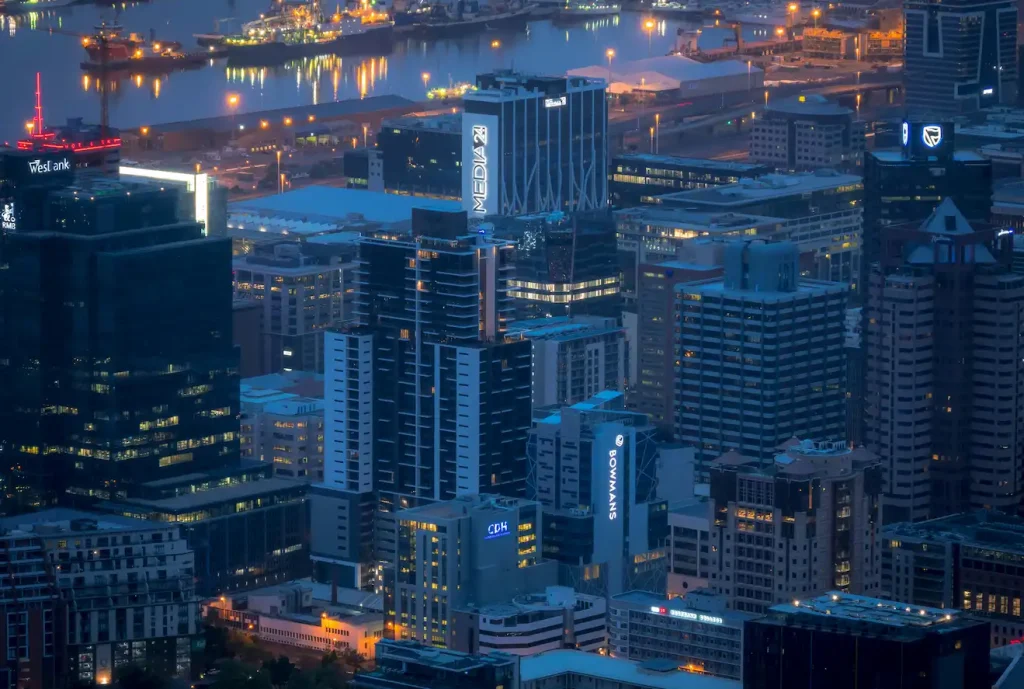
# Cape Town’s CBD: Beyond the Postcard Attractions
Most visitors to Cape Town head straight for Table Mountain, the V&A Waterfront, or the beaches of the Southern Suburbs. The CBD—the central business district that forms the city’s historic core—rarely makes the cut. That’s a mistake. While the area was quieter in previous decades, it has undergone a genuine revival, and there is genuine work happening here. For travellers with even a few hours to spare, the CBD rewards curiosity.
The neighbourhood extends from the railway station inland through the grid of colonial-era streets, bound loosely by the mountain to the south and the harbour to the north. What makes it worth your time is that it remains a working city centre, not a theme park. You will see offices, shops, schools, and people conducting ordinary business. Within that reality sit several worthwhile destinations and the kind of street-level energy that tends to disappear when places are entirely tourism-focused.
## Where to start: The markets
Greenmarket Square is the obvious entry point. Operating since 1696, it is still the CBD’s liveliest gathering space. The square opens at 09:00 and runs until 18:00 daily, with stalls selling local crafts, artwork, textiles, and food. It is genuinely busy most days—locals shopping, tourists browsing, street musicians performing. The energy is real, not manufactured for cameras. Entry is free, and prices for souvenirs and street food are reasonable by international standards. If you are looking for a genuine Cape Town moment rather than a packaged experience, this is it.
Company’s Garden sits two blocks south and offers something altogether different. Established in 1652 by the Dutch East India Company as a vegetable garden to supply ships, it has evolved into a public park with mature trees, walking paths, and open lawns. The garden opens at 07:00 and closes at 18:00, with no entry fee. It is a place to slow down—to sit on grass, eat lunch, watch local people pass through, and look back toward the CBD and Table Mountain. The garden hosts a Saturday market with food, crafts, and occasionally live music, though the event is smaller and quieter than Greenmarket Square.
Within the same precinct sits the Iziko South African Museum and Planetarium. The museum holds an extensive collection of South African and African art across both historic and contemporary works. The planetarium is in the same building and uses digital projection to recreate the night sky. Entry costs R130 for international visitors and includes access to both spaces. Opening hours are Tuesday to Sunday, 10:00–11:30 and 12:30–14:00. It is a solid option if the weather turns poor or if you want structured time indoors.
## Navigating the streets
The Fan Walk runs from the CBD toward Green Point along the waterfront, a pedestrian path built for the 2010 FIFA World Cup. It is approximately 5 kilometres long and takes most visitors 45 minutes to an hour to complete. The walk passes through De Waterkant, a neighbourhood of converted warehouses and restaurants, and offers water views without the crowds of the Waterfront proper. It is used regularly by locals for exercise, which is a good sign that it feels reasonably safe and well-maintained.
Long Street and Bree Street form the CBD’s nightlife and dining spine. Both streets are lined with restaurants, bars, galleries, and shops. They are busiest in the evening, particularly from Thursday onward. If you prefer daytime exploration, you will find the streets quieter and easier to navigate on foot. The concentration of places to eat and drink here is genuine; you can spend several hours moving between venues without much repetition. This is where the CBD’s revival is most visible.
First Thursday events occur on the first Thursday of each month and transform parts of the CBD into an open-air gallery and street party. Galleries open late, DJs set up in public spaces, there are sculpture installations, and street vendors appear. These events are free and unticketted, running in the evening from around 18:00 onward. They draw a mix of locals and visitors and are popular enough that the streets feel safe and well-populated. If your dates align, it is worth timing a CBD visit to coincide with one.
## Street art and the Bo-Kaap
The CBD holds a collection of street art, though Cape Town’s street art scene is more distributed across the city than concentrated in one area. Walking the CBD’s alleys and side streets, you will encounter murals and painted walls. Some are works of local artists; others come from international visitors who have left marks on the city. A guided street art tour can provide context and access to less obvious pieces, though self-directed walking also reveals plenty if you keep your eyes up.
The Bo-Kaap sits immediately north and slightly uphill from the CBD, easily reached on foot in 10 minutes from Greenmarket Square. The neighbourhood is known for its painted houses in bright colours—yellows, oranges, blues, greens—stacked closely together on steep streets. It is not a hidden treasure in the sense of being undiscovered; it is genuinely popular, and you will encounter other tourists. What you will also encounter are local residents, children playing, women hanging laundry, and people conducting daily life. That mix—between tourism and lived reality—gives the Bo-Kaap a texture that purely touristic places lack.
The Bo-Kaap Museum documents the area’s history and the Cape Malay culture that settled here from the 17th century onward. Expect modest displays and limited labelling, but genuine historical substance. More important than the museum, though, is walking the streets and eating. Several small restaurants and food stalls serve Cape Malay cuisine—curries, breads, sweet dishes—that fuses African, Dutch, and Indonesian elements. The food is often excellent and priced below what international chains charge in the Waterfront.
## Saturday mornings
Oranjezicht City Farm Market runs Saturday mornings at Granger Bay, on the waterfront edge of the CBD. It features local farmers selling produce, bakers selling bread, makers selling honey and preserves, and small food vendors offering ready-to-eat items. There is typically live music—solo musicians or small bands playing in the background. The market draws a mixed crowd of locals and visitors and has a genuinely friendly atmosphere. Prices are higher than supermarkets but reasonable given the quality and local sourcing. It opens around 09:00 and finishes by early afternoon.
## Practical considerations
The CBD is best explored on foot, though it helps to have a sense of direction or a map. Major streets run north-south and east-west in a grid, making navigation straightforward once you have oriented yourself. Greenmarket Square and Company’s Garden are both central reference points.
Safety in the CBD is worth mentioning plainly. Certain areas are busier and more populated than others, and like any urban centre, basic precautions apply—do not display expensive cameras or jewellery, avoid quiet side streets at night, and travel with company if you are uncertain. The populated main streets and market areas are generally fine during daytime hours. First Thursday events bring large crowds and feel safe. Evening dining on Long Street and Bree Street is normal and popular. If you are uncertain about a particular area or time, ask hotel staff or locals; they can give you current, specific advice that is far more useful than general warnings.
Parking in the CBD can be difficult if you are driving. If you arrive by car, use a parking garage or arrange parking at your accommodation before exploring on foot. Most attractions are within 20 minutes’ walk of one another, so it is feasible to see several in a morning or afternoon.
The CBD does not require a full day—a few hours will let you cover the main spots. Many visitors combine it with other parts of the city in a single outing: a morning at Greenmarket Square and Company’s Garden, then a walk along the Fan Walk toward the Waterfront, or a morning at the Bo-Kaap, followed by lunch on Long Street. Time is flexible depending on your pace and interests.