
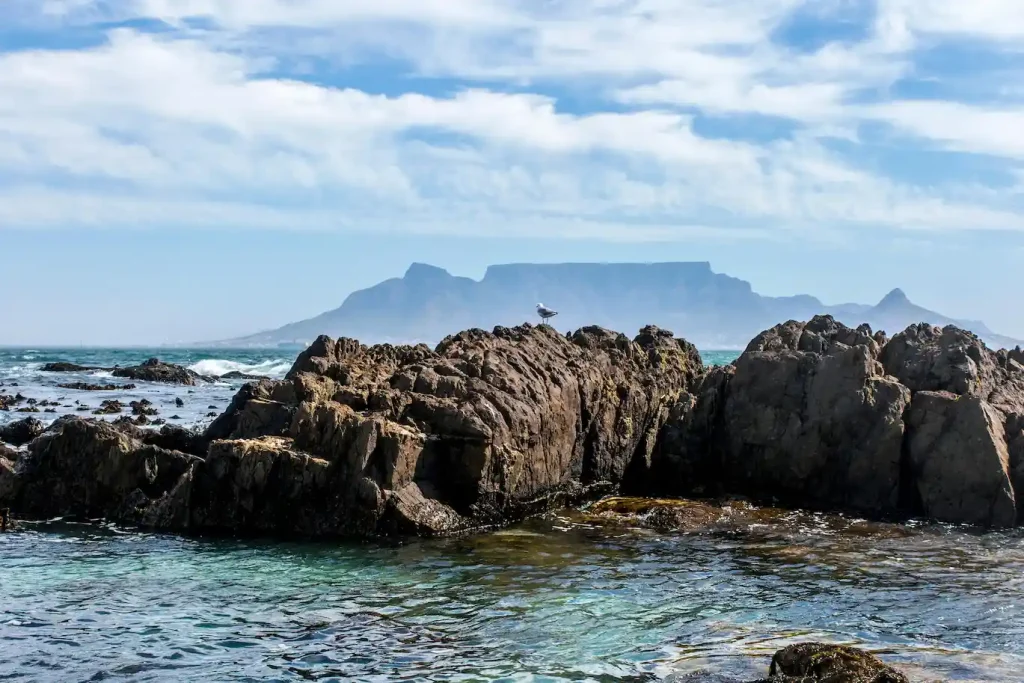
Robben Island lies 6.9 kilometres off the coast of Cape Town, a small, oval-shaped landmass covering just 5.07 square kilometres. Its modest size belies its historical weight. From the 17th century onward, the island served as a place of exile, confinement, and control. Most notably, it housed political prisoners during South Africa’s apartheid era, including Nelson Mandela, who spent 18 of his 27 years of imprisonment here. Today, it is a UNESCO World Heritage Site and one of Southern Africa’s most visited historical destinations.
Robben Island: A Journey Through South Africa’s History
For international travellers, a visit to Robben Island offers more than a tour of a former prison. It provides a direct encounter with the personal testimony of those who were imprisoned there, a chance to walk the spaces where political resistance continued under brutally restricted circumstances, and an understanding of how South Africa moved from that system toward democracy.
The Geography and Practical Setting
Robben Island sits in Table Bay with a Mediterranean climate: mild, wet winters averaging 11°C and warm, dry summers reaching 26°C. Annual rainfall is around 700 millimetres, concentrated in winter months. The island’s small size means it can be explored thoroughly in a single visit.

Access is straightforward. Ferries depart from the Nelson Mandela Gateway at the V&A Waterfront in Cape Town, a journey of approximately 30 minutes. Tours run at 09h00, 11h00, 13h00 and 15h00. During peak season, November through March, tours typically sell out 2 to 4 weeks in advance, so booking ahead is essential. The online system opens reservations around 60 days before each departure date.
Visitors disembark at Murray’s Bay Harbour on the island’s east coast. From there, buses transport visitors to the main historical sites. A standard tour lasts 3.5 hours including ferry time. An alternative 5-hour walking tour covers a 5-kilometre guided route, allowing visitors to walk the actual paths used by prisoners and staff.
The Prison and Its History
The island was fortified and used as a prison from the late 17th century. However, its most significant period came during the late 20th century, when the apartheid government imprisoned political opponents there from the 1960s until 1996.
Among the prisoners held on Robben Island were Nelson Mandela, Walter Sisulu, Ahmed Kathrada, and Govan Mbeki. Mandela was one of 27 years imprisoned and spent 18 of those years on the island, primarily in the maximum-security section.
Conditions were deliberately harsh. Prisoners performed forced labour in the island’s limestone quarry, a feature now incorporated into the tour. They endured beatings, solitary confinement, and severe restrictions. Despite this, many continued their political work and reflection during their time on the island, and upon release, they remained central to the anti-apartheid movement.
The maximum-security prison complex includes multiple buildings and cell blocks. The most visited space is the section where Mandela was held; a small cell approximately 2.4 metres by 2.1 metres. Visitors can stand in this space and see the conditions under which he spent nearly two decades.
The prison closed in 1996, following the end of apartheid and South Africa’s transition to democracy. UNESCO designated Robben Island a World Heritage Site in 1999, recognising it for what the World Heritage Committee described as a “triumph of the human spirit.”
The Tour Experience
Visitors to Robben Island are required to join a guided tour; independent exploration is not permitted. This structure exists both for safety and to ensure the historical narrative is told accurately and with appropriate context.
The most significant aspect of any Robben Island tour is that it is led, in whole or in part, by former political prisoners. These guides provide first-hand accounts of daily life, the psychological impact of confinement, and the strategies prisoners used to maintain dignity and continue their political work. This human element is what transforms the tour from a historical site visit into something closer to a testimony.
The tour typically includes:
A bus journey around the island, with stops at various landmarks. The lime quarry, where prisoners were forced to extract limestone by hand, is a sobering sight. The intense brightness of the white rock and the narrow space where hundreds laboured are viscerally apparent. Guides explain both the physical toll and the psychological strategy involved: prisoners were permitted to work in groups, which allowed for conversation and mutual support.
A visit to the maximum-security prison building, where the cells are preserved. The prison section includes the exercise yard where inmates were allowed limited time outdoors, and various administrative and punitive spaces. Visitors see Mandela’s cell, as well as cells of other imprisoned leaders. The spareness of these spaces is often the most striking feature to visitors accustomed to more modern conditions.
Visits to other significant structures on the island. Sobukwe House, where Robert Sobukwe (another prominent anti-apartheid figure) was held in solitary confinement for extended periods, is included. The island’s lighthouse, built in 1865 and standing 18 metres tall, is the second-oldest working lighthouse in South Africa and remains operational.
A visit to the Visitors’ Centre provides contextual information, archival materials, and biographical details of prisoners.
The total experience, ferry, bus tour, guided prison visit, and return journey, takes 3.5 to 4 hours.
Wildlife and the Island Environment
Beyond its historical significance, Robben Island supports populations of African penguins, seabirds including cormorants and terns, and seals. Dolphins are sometimes visible in the surrounding waters. While wildlife observation is not the primary purpose of visits, the island’s natural features provide context for understanding what imprisonment on an isolated island meant in practical terms.
Practical Information for Visitors
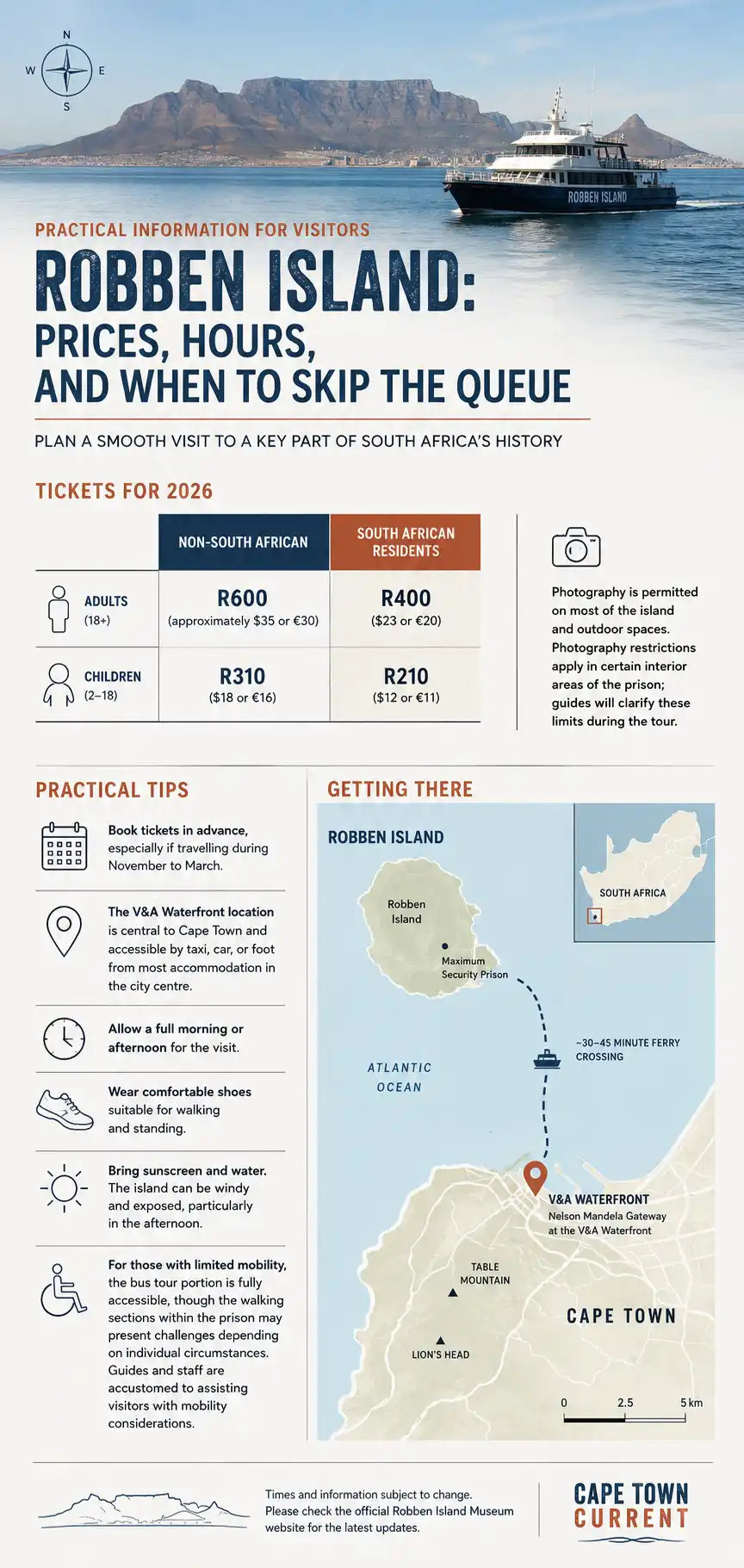
Tickets for 2026 are priced at R600 (approximately $35 or €30) for non-South African adults and R310 ($18 or €16) for non-South African children aged 2–18. South African residents pay R400 ($23 or €20) for adults and R210 ($12 or €11) for children.
Photography is permitted on most of the island and outdoor spaces. Photography restrictions apply in certain interior areas of the prison; guides will clarify these limits during the tour.
Book tickets in advance, especially if travelling during November to March. The V&A Waterfront location is central to Cape Town and accessible by taxi, car, or foot from most accommodation in the city centre.
Allow a full morning or afternoon for the visit. Wear comfortable shoes suitable for walking and standing. Bring sunscreen and water. The island can be windy and exposed, particularly in the afternoon.
For those with limited mobility, the bus tour portion is fully accessible, though the walking sections within the prison may present challenges depending on individual circumstances. Guides and staff are accustomed to assisting visitors with mobility considerations.
Why Visit
Robben Island functions as a historical document made tangible. The spaces themselves, the cells, the quarry, the exercise yard, convey information that description alone cannot. The testimony of former prisoners transforms this physical experience into something personal and human rather than abstract.
The island’s history intersects with broader narratives of political imprisonment, resistance, and reconciliation, but its primary value lies in the specificity of what occurred there and the people who endured it. Understanding Robben Island requires engaging with particular names, dates, and experiences rather than generalising about historical periods.
For international travellers to South Africa, Robben Island offers an opportunity to engage directly with recent history through both the physical environment and the voices of those who lived through it. It remains one of the most substantive historical experiences available in Cape Town.